Website owners often focus on content, backlinks, and keywords when trying to improve search rankings. While those factors remain important, technical performance also plays a major role in SEO success. One of the most discussed technical factors is page speed.
If you’ve ever wondered does page speed affect SEO, the short answer is yes. Website speed influences user experience, engagement metrics, and search engine rankings. However, many business owners still underestimate its impact.
Today, users expect websites to load almost instantly. If a page takes too long to appear, visitors often leave before they even see the content. Consequently, slow websites lose traffic, leads, and sales opportunities.
Search engines understand this behavior. Therefore, they consider page performance when evaluating websites. In this guide, you’ll learn how page speed affects SEO, why website performance matters, and what you can do to improve loading times.
Does Page Speed Affect SEO Directly?
Google has publicly confirmed that page experience signals contribute to search rankings. While content quality remains the most important factor, page speed can influence how search engines evaluate user experience.
A faster website helps search engines:
- Crawl pages more efficiently
- Deliver better user experiences
- Reduce frustration among visitors
- Improve overall website quality signals
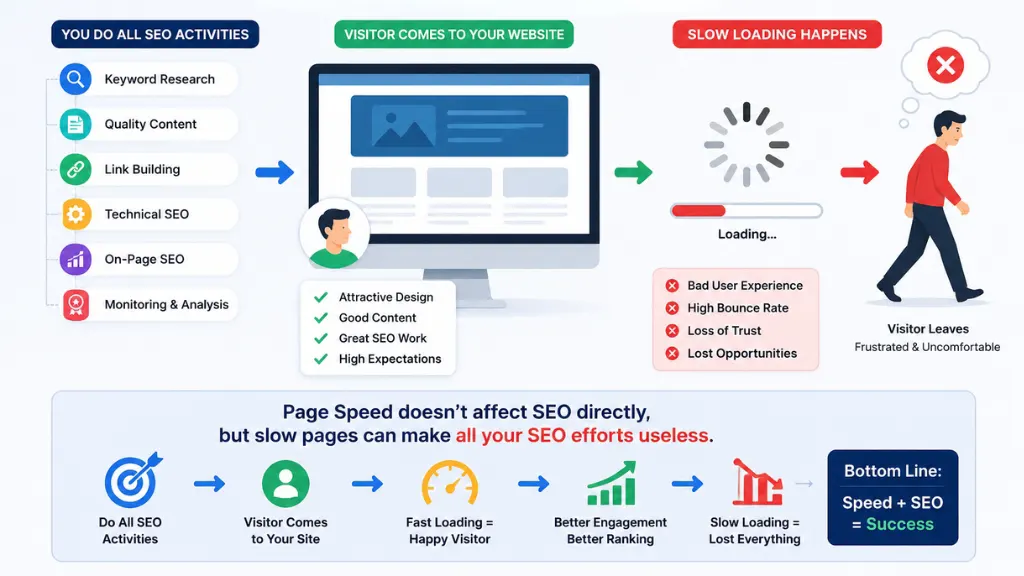
Therefore, speed can contribute to improved visibility when other ranking factors are similar. However, page speed alone will not guarantee top rankings. Instead, it works alongside content quality, relevance, backlinks, and technical SEO.
Why Website Speed Matters for Users
Search engines prioritize user satisfaction. Consequently, they reward websites that provide positive experiences.
When a website loads quickly:
- Visitors stay longer
- Users view more pages
- Engagement improves
- Conversions increase
On the other hand, slow-loading websites often create frustration. Many users abandon a page within seconds if it doesn’t load properly. Because user behavior affects website performance metrics, page speed indirectly influences SEO outcomes.
Common Causes of Slow Website Speed
Many factors contribute to slow performance.
Large Images: Oversized images frequently become one of the biggest performance issues.
Excessive Plugins: Too many plugins can increase server requests and loading times.
Poor Hosting: Low-quality hosting often limits website performance.
Unoptimized Code: Heavy JavaScript and CSS files may slow page rendering.
Multiple Redirects: Redirect chains increase loading delays.
Lack of Caching: Without caching, browsers must repeatedly download resources.
Identifying these issues is often the first step toward performance improvement.
Does Page Speed Matter More Than Content?
No. Content quality remains the foundation of successful SEO. A fast website with weak content rarely performs well. However, excellent content on a slow website may struggle to reach its full potential.
The best approach combines:
- High-quality content
- Strong SEO
- Excellent user experience
- Fast website performance
Together, these elements create a stronger overall website.
How to Improve Website Speed
Improving speed often requires multiple optimizations.
Optimize Images: Compress images without sacrificing quality. Additionally, use modern image formats whenever possible.
Enable Browser Caching: Caching stores resources locally, reducing loading times for returning visitors.
Minimize Code: Remove unnecessary
- JavaScript
- CSS
- HTML
This reduces file sizes and improves efficiency.
Choose Better Hosting: High-quality hosting typically delivers faster performance and improved reliability.
Use a Content Delivery Network (CDN): CDNs distribute content across global servers. Consequently, users receive content from locations closer to them.
Reduce Third-Party Scripts: Limit unnecessary tracking tools and external integrations. Because each external request adds loading time, fewer scripts often improve performance.
Final Thoughts
So, does page speed affect SEO?
Yes, page speed influences search performance, user experience, engagement, and conversion rates. While it is not the most important ranking factor, it plays a significant role in overall website success.
Fast websites create better experiences for visitors. Moreover, they help search engines crawl content efficiently and support stronger engagement metrics.
Businesses should view speed optimization as part of a broader SEO strategy rather than a standalone solution.
When combined with high-quality content, strong technical SEO, and valuable user experiences, a fast website becomes a powerful asset for long-term growth.
FAQ's
Yes. Page speed contributes to user experience and page experience signals, which can influence search rankings.
Google has confirmed that page experience signals, including performance-related factors, contribute to rankings.
You can use tools like Google PageSpeed Insights, GTmetrix, Lighthouse, and Pingdom.
Yes. Mobile performance is especially important because Google primarily uses mobile-first indexing.
Yes. Faster websites often improve user engagement, reduce bounce rates, and increase conversion opportunities.