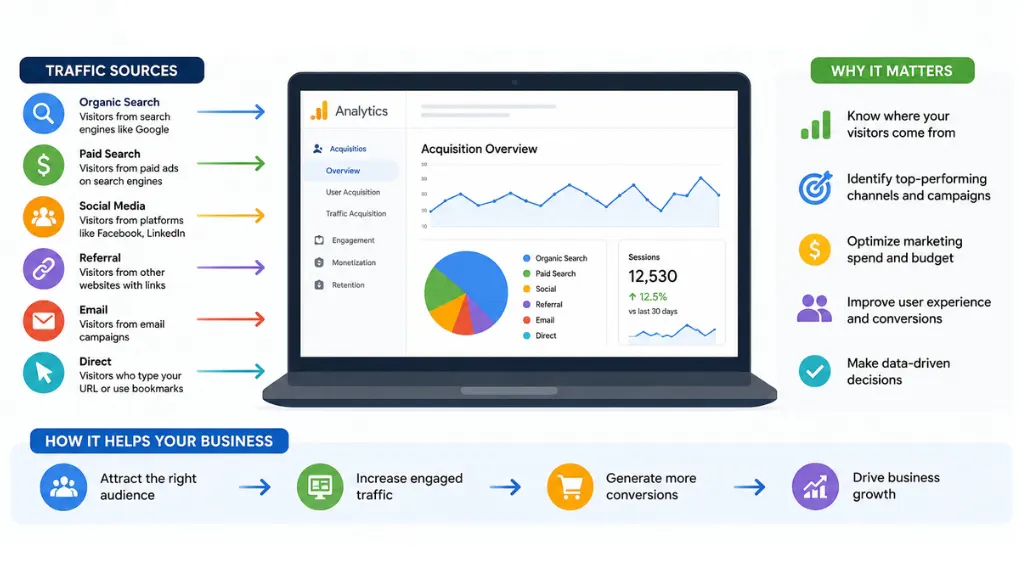
Acquisition in Google Analytics helps you identify how users discover and reach your website. It shows whether visitors arrive through search engines, social media, paid advertisements, email campaigns, referral websites, or direct visits. As a result, you can evaluate marketing performance and make smarter decisions about your budget and strategy.
In this guide, you will learn what acquisition means in Google Analytics, why it matters, how acquisition reports work, and how to use acquisition data to improve your marketing efforts.
Main Acquisition Channels in Google Analytics
Understanding acquisition channels helps you interpret reports more effectively.
Organic Search
Organic search traffic comes from unpaid search engine results.
Visitors find your website by searching on platforms such as:
- Bing
- Yahoo
- DuckDuckGo
For example, a user searches for “best running shoes” and clicks your website in the search results.
Organic traffic often delivers high-quality visitors because users actively search for relevant information. Therefore, many businesses invest heavily in search engine optimization (SEO).
Direct Traffic
Direct traffic occurs when users access your website without a detectable referral source.
This happens when visitors:
- Type your URL directly
- Use browser bookmarks
- Click untracked links
- Open saved website shortcuts
Although direct traffic appears straightforward, it can sometimes include traffic from improperly tagged campaigns.
Referral Traffic
Referral traffic comes from external websites that link to your content.
For example, a visitor may click a backlink from:
- An industry blog
- A news website
- A partner company website
Referral traffic often indicates strong content marketing and link-building efforts.
Organic Social Traffic
Organic social traffic comes from unpaid social media activity.
Examples include:
- Facebook posts
- Instagram content
- LinkedIn updates
- X posts
- Pinterest shares
When users click these links and visit your website, Google Analytics categorizes them as organic social traffic.
Paid Search Traffic
Paid search traffic comes from advertising campaigns on search engines.
Examples include:
- Google Ads
- Microsoft Ads
Since advertisers pay for clicks, tracking acquisition performance becomes especially important. Consequently, businesses can measure return on investment and adjust spending accordingly.
Email Traffic
Email traffic originates from email marketing campaigns.
Visitors arrive after clicking links within:
- Newsletters
- Promotional emails
- Product announcements
- Customer retention campaigns
Email often generates highly engaged users because subscribers already have an interest in the brand.
Display Traffic
Display traffic comes from banner advertisements and display network campaigns.
These ads appear across websites, mobile applications, and digital platforms.
Although display campaigns primarily support brand awareness, they can also drive conversions when targeted effectively.
Acquisition Reports in Google Analytics
Google Analytics 4 includes several acquisition reports that help marketers analyze traffic sources.
User Acquisition Report
The User Acquisition Report focuses on how new users first discover your website.
This report answers questions such as:
- Which channels attract new visitors?
- Which campaigns generate the most first-time users?
- Which sources drive audience growth?
As a result, marketers can evaluate customer acquisition efforts more accurately.
Traffic Acquisition Report
The Traffic Acquisition Report examines all sessions rather than only new users.
This report helps you understand:
- Which channels drive overall traffic
- Which sources generate engagement
- Which campaigns support conversions
Because it includes returning users, it provides a broader view of website performance.
Acquisition Overview Report
The Overview Report presents a summary of acquisition metrics in a single dashboard.
Users can quickly view:
- Traffic trends
- Top channels
- Session data
- User activity
- Conversion performance
Therefore, it serves as an excellent starting point for analysis.
Key Metrics to Analyze in Acquisition Reports
Acquisition reports become more useful when you understand the metrics behind them.
Users
Users represent individual visitors who interact with your website. A higher number of users generally indicates broader audience reach.
Sessions
Sessions measure individual visits to your website. One user may generate multiple sessions over time. Therefore, sessions often exceed user counts.
Engaged Sessions
GA4 emphasizes engagement rather than bounce rate.
An engaged session occurs when users:
- Stay longer than 10 seconds
- View multiple pages
- Complete a conversion event
This metric helps identify meaningful interactions.
Engagement Rate
Engagement rate measures the percentage of engaged sessions. A higher engagement rate often signals relevant traffic and positive user experiences.
Conversions
Conversions represent desired actions completed by users.
Examples include:
- Purchases
- Form submissions
- Newsletter sign-ups
- Downloads
Acquisition reports help determine which channels generate the most conversions.
Revenue
For e-commerce websites, revenue metrics reveal how much income each traffic source generates. Consequently, marketers can identify the most profitable channels.
How to Use Acquisition Data to Improve Marketing Performance
Collecting data alone does not create value. Instead, you must use insights to make better decisions.
Invest More in High-Performing Channels
First, identify channels that generate strong engagement and conversions. For example, if organic search produces the highest revenue, you may increase investment in SEO efforts. As a result, you can maximize long-term growth opportunities.
Optimize Underperforming Campaigns
Next, examine channels with high traffic but low conversion rates.
You may discover issues such as:
- Weak landing pages
- Poor audience targeting
- Irrelevant messaging
After identifying these problems, you can make targeted improvements.
Improve Campaign Tracking
Many businesses struggle with incomplete acquisition data because they fail to use proper tracking parameters. Therefore, always use UTM tags when promoting content through:
- Email campaigns
- Social media ads
- Influencer partnerships
- Paid promotions
Accurate tracking leads to more reliable reporting.
Strengthen Content Strategy
Acquisition reports can reveal which content attracts the most visitors. For example, certain blog topics may consistently generate organic traffic. In that case, you can create additional content around similar themes to increase visibility.
Enhance Customer Journeys
Different channels often attract users at different stages of the buying process. Some channels drive awareness, while others encourage purchases. By analyzing acquisition patterns, you can design marketing strategies that guide users from discovery to conversion more effectively.
Conclusion
Acquisition in Google Analytics refers to the process of understanding how users find and arrive at your website. It provides detailed insights into traffic sources, marketing channels, campaigns, and user behavior. More importantly, acquisition data helps businesses evaluate marketing effectiveness and allocate resources wisely.
By analyzing acquisition reports, marketers can identify top-performing channels, optimize campaigns, improve content strategies, and increase conversions. Furthermore, they can make informed decisions based on real user behavior rather than assumptions.
Whether you manage a blog, an e-commerce store, or a corporate website, acquisition reporting serves as a foundation for digital marketing success. Therefore, learning how to interpret and act on acquisition data should become a key part of your analytics strategy.
FAQ's
Acquisition in Google Analytics refers to the process of tracking how users find and arrive at your website. It helps identify traffic sources such as organic search, social media, paid ads, referrals, email campaigns, and direct visits.
The Acquisition Report helps marketers understand which channels and campaigns drive the most traffic, engagement, and conversions. As a result, businesses can optimize their marketing strategies and allocate budgets more effectively.
User Acquisition focuses on how new users first discover your website, while Traffic Acquisition analyzes all sessions, including those from returning visitors. Therefore, User Acquisition measures audience growth, whereas Traffic Acquisition provides a broader view of website performance.
Google Analytics tracks several acquisition channels, including Organic Search, Direct, Referral, Organic Social, Paid Search, Email, Display, and Affiliate traffic. These channels help businesses understand where their visitors originate.
Acquisition data helps identify high-performing traffic sources, optimize underperforming campaigns, improve content strategies, and increase conversions. Furthermore, it enables businesses to make data-driven decisions that support long-term growth.