
If you’ve ever run a digital marketing campaign, managed a website, or tracked online advertising performance, you’ve probably encountered the term CVR. However, many business owners and marketers still wonder exactly how CVR impacts their marketing success.
So, what is CVR in digital marketing and why does it matter?
CVR stands for Conversion Rate. It measures the percentage of users who complete a desired action after visiting your website, landing page, or advertisement.
While traffic is important, conversions ultimately determine whether your marketing efforts generate results. Therefore, understanding and improving CVR can significantly increase revenue without necessarily increasing marketing spend.
In this guide, you’ll learn what CVR means, how to calculate it, why it’s important, and practical ways to improve conversion performance across your digital marketing campaigns.
What Is CVR in Digital Marketing?
To answer the common question, what is CVR in digital marketing, CVR stands for Conversion Rate.
A conversion occurs whenever a user completes a desired action.
Examples include:
- Making a purchase
- Filling out a contact form
- Signing up for a newsletter
- Downloading an ebook
- Requesting a quote
- Registering for a webinar
- Creating an account
CVR measures how effectively your website or campaign turns visitors into customers or leads.
Because marketing success depends on results rather than traffic alone, conversion rate serves as one of the most important performance indicators.
Why CVR Matters in Digital Marketing
Many businesses focus heavily on generating traffic. However, attracting visitors represents only part of the process. Without conversions, traffic produces limited business value.
A strong conversion rate helps businesses:
Increase Revenue: Higher conversion rates generate more sales from existing traffic.
Improve Marketing ROI: Better conversions allow businesses to maximize advertising investments.
Reduce Customer Acquisition Costs: More conversions often mean lower costs per customer.
Identify Website Performance Issues: CVR reveals weaknesses in user experience and sales funnels.
Improve Business Growth: Consistent conversion optimization supports long-term profitability.
Therefore, marketers often prioritize conversion improvements alongside traffic growth strategies.
How to Calculate CVR
Fortunately, calculating conversion rate is simple.
The formula is:
CVR = (Conversions ÷ Total Visitors) × 100
For example:
- Website visitors: 5,000
- Purchases: 250
Calculation:
(250 ÷ 5,000) × 100 = 5%
In this case, the conversion rate equals 5%.
That means 5% of visitors completed the desired action.
Understanding Different Types of Conversions
Not every conversion involves a sale.
Businesses define conversions based on specific goals.
Sales Conversions
These occur when visitors purchase products or services.
Lead Generation Conversions
Examples include:
- Contact form submissions
- Consultation requests
- Quote requests
Engagement Conversions
Visitors may:
- Download resources
- Watch videos
- Register for events
Subscription Conversions
Users sign up for:
- Newsletters
- Memberships
- Free trials
Because every business has different objectives, conversion definitions may vary.
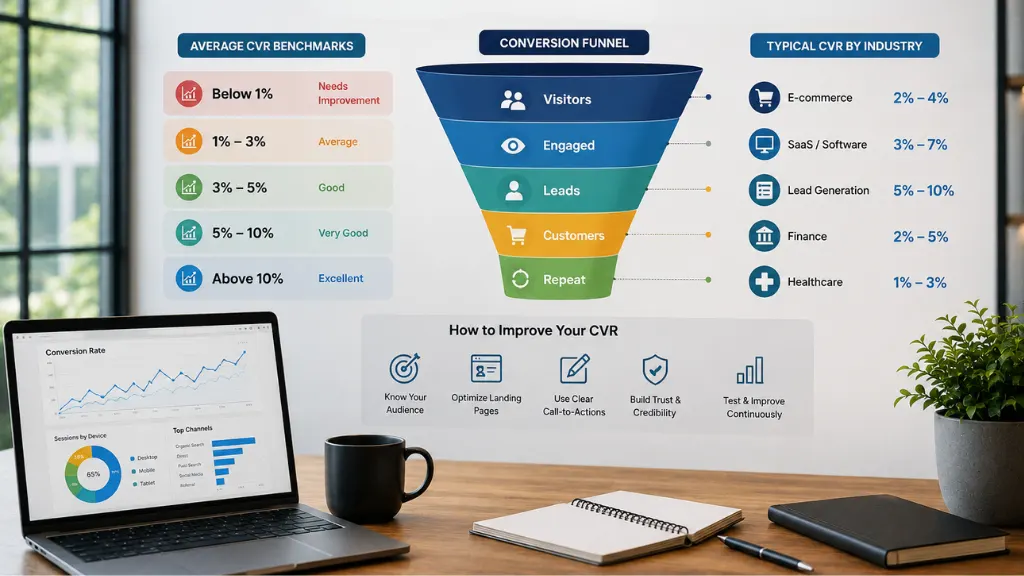
What Is a Good CVR in Digital Marketing?
One of the most common questions after learning what is CVR in digital marketing is:
“What is considered a good conversion rate?”
The answer depends on several factors:
- Industry
- Traffic source
- Product type
- Audience quality
- Website experience
Generally:
Conversion Rate | Performance |
Below 1% | Needs Improvement |
1%–3% | Average |
3%–5% | Good |
5%–10% | Very Good |
Above 10% | Excellent |
However, benchmarks vary significantly across industries.
For example, eCommerce stores may have different standards than B2B service companies.
Factors That Influence Conversion Rate
Several elements affect conversion performance.
Understanding these factors helps marketers identify improvement opportunities.
Website Design
A clean, professional website creates trust and encourages action.
Important elements include:
- Easy navigation
- Mobile responsiveness
- Fast loading speed
- Clear layouts
Poor design often reduces conversions.
User Experience
Visitors should complete actions without confusion.
Strong user experiences provide:
- Clear pathways
- Simple forms
- Easy checkout processes
- Logical page structures
As a result, users encounter fewer barriers during their journey.
Traffic Quality
Not all traffic converts equally.
Targeted visitors typically perform better than broad, untargeted audiences.
Therefore, attracting qualified traffic remains essential.
Call-to-Action Effectiveness
Strong CTAs encourage users to take action.
Examples include:
- Get Started Today
- Request a Free Quote
- Schedule Your Consultation
Clear CTAs often improve conversion performance.
How CVR Impacts Paid Advertising
Conversion rate plays a critical role in advertising success.
Whether using Google Ads, Facebook Ads, LinkedIn Ads, or other platforms, CVR influences profitability.
For example:
Campaign A:
- 1,000 clicks
- 10 conversions
- 1% CVR
Campaign B:
- 1,000 clicks
- 50 conversions
- 5% CVR
Although both campaigns generate the same traffic, Campaign B produces significantly better results.
Consequently, improving conversion rate often provides greater returns than simply increasing advertising budgets.
Common Reasons for Low Conversion Rates
Many businesses experience conversion challenges.
Fortunately, identifying the causes often leads to significant improvements.
Slow Website Speed: Users expect fast experiences. Even minor delays can reduce conversions.
Weak Value Proposition: Visitors need clear reasons to choose your business.
Poor Mobile Experience: Mobile users now represent a significant percentage of website traffic.
Complicated Forms: Long forms often discourage completion.
Lack of Trust Signals: Trust-building elements include
- Customer reviews
- Testimonials
- Certifications
- Security badges
Without trust, visitors hesitate to convert.
Proven Ways to Improve CVR
Conversion rate optimization focuses on improving performance without increasing traffic.
Several proven techniques can help.
Improve Landing Pages
Effective landing pages include:
- Clear headlines
- Strong benefits
- Compelling visuals
- Simple navigation
Focused landing pages often convert better than generic pages.
Optimize Call-to-Actions
Make CTAs:
- Visible
- Clear
- Action-oriented
Small CTA changes can create measurable improvements.
Reduce Form Fields
Ask only for essential information. Shorter forms often increase completion rates.
Strengthen Social Proof
Customer testimonials and reviews help build confidence. When visitors see positive experiences from others, they feel more comfortable taking action.
Test Different Variations
A/B testing helps identify which elements perform best.
Businesses commonly test:
- Headlines
- CTA buttons
- Images
- Layouts
- Form designs
Continuous testing supports ongoing improvement.
CVR and SEO: How They Work Together
SEO drives traffic. CVR converts that traffic into business results. While rankings matter, conversion optimization determines profitability.
A successful strategy combines:
Quality Traffic: SEO attracts relevant visitors.
Strong Content: Helpful content builds trust.
Optimized User Experience: Visitors can easily complete desired actions.
Effective Conversion Paths: Clear next steps encourage engagement.
Together, SEO and conversion optimization create stronger marketing performance.
Tools for Tracking Conversion Rate
Several tools help marketers monitor CVR.
Popular options include:
Google Analytics: Tracks website traffic and conversions.
Google Ads: Measures advertising conversion performance.
Hotjar: Provides user behavior insights.
Microsoft Clarity: Analyzes visitor interactions.
CRM Platforms: Track leads and sales conversions.
Using these tools helps businesses make informed optimization decisions.
Final Thoughts
Understanding CVR in digital marketing is essential for anyone looking to improve marketing performance.
Conversion rate measures how effectively your website, landing pages, and campaigns turn visitors into customers or leads.
While traffic generation remains important, higher conversion rates often produce faster and more cost-effective growth.
By focusing on user experience, website optimization, targeted traffic, and continuous testing, businesses can improve CVR and maximize the value of every marketing dollar.
The most successful marketers don’t just attract visitors they convert them.