
Picking the right keywords is one of the first few steps to building an effective SEO strategy. Keywords — As in keywords-linked to what people search and the pages on the site. Attracting the wrong visitors If you target wrong terms then they will never going to buy it. To get to the other hand, specific keywords can put your products in front of those who are searching for it. But keyword research is not just about hunting for high search volume phrases. You should also factor in search intent, competition, relevance and location; even the stage of the buyer’s journey.
With this guide, you will know how to select keywords appropriate for your website, evaluate the potential those keywords may have, and choose terms that can drive organic traffic while also enhancing business objectives.
What Are Keywords in SEO?
Keywords are words or phrases people enter into search engines when looking for information, products, services, or solutions.
For example, a person looking for an SEO company might search for:
- SEO services
- SEO agency for small business
- local SEO services
- technical SEO services
- SEO company near me
These phrases can help a business understand what its potential customers want to find.
However, a keyword doesn’t always have to be a short phrase. Long-tail searches such as “how to choose keywords for a small business website” can also be useful because they often describe a very specific need.
How to Choose Keywords for Your Website
A good keyword selection process starts with your business rather than a keyword tool.
1. Understand Your Products and Services
Start by making a list of everything your business offers.
For example, a digital marketing agency might offer:
- SEO services
- Social media marketing
- Content marketing
- PPC advertising
- Local SEO
- Web development
Each service can have its own group of keywords.
This approach keeps your research connected to actual business offerings.
2. Identify Your Target Audience
Next, think about who you want to attract.
Ask yourself:
- Who buys this product or service?
- What problems do they have?
- What questions do they ask?
- What words would they use when searching?
- Are they looking for information or ready to purchase?
For example, a small business owner may search for “digital marketing agency for small business”, while a marketing professional may search for “enterprise SEO strategy.”
Both searches relate to digital marketing, but the audience and intent are different.
3. Start With Seed Keywords
Seed keywords are simple terms that describe your main products, services, or topics. Suppose you run a solar business.
Your seed keywords might include:
- solar panels
- solar inverter
- solar battery
- solar panel kit
- solar system
You can then use these terms to discover more specific keyword ideas.
For example:
Solar panels → solar panels for home → solar panels for small house → solar panel installation cost
This process gives you a larger list to evaluate.
4. Use Keyword Research Tools
Keyword research tools can help you understand the potential of different search terms.
Popular tools include:
- Google Keyword Planner
- Google Search Console
- Ahrefs
- Semrush
- Ubersuggest
These tools can provide information such as search volume, keyword variations, competition, and related terms.
However, don’t rely entirely on the numbers.
A keyword tool might show that a particular phrase receives thousands of searches, but that doesn’t mean it will bring the right customers.
Use the data as a guide, then evaluate the keyword from a business and search-intent perspective.

How to Choose Best Keywords
When comparing keywords, consider several factors rather than focusing on one metric.
Relevance
The keyword should closely relate to the page and your business. If you offer professional SEO services, “SEO services” is relevant. A keyword such as “SEO definition” may attract people who only want basic information and aren’t looking for a service.
Search Volume
Search volume tells you approximately how often people search for a keyword. Higher volume can mean more potential traffic. However, it can also mean stronger competition. A lower-volume keyword can still be a good choice if it attracts highly relevant visitors.
Competition
Look at how difficult it may be to compete for the keyword. Large brands and established websites often dominate highly competitive searches. If your website is relatively new, targeting specific long-tail keywords can give you more realistic opportunities.
Business Intent
Consider whether the keyword can contribute to your business goals.
For example:
“what is SEO” has primarily informational intent.
“SEO services for small business” has stronger commercial intent.
Both can be useful, but they serve different purposes.
Conversion Potential
Think beyond traffic. A keyword that generates 100 highly relevant visitors may be more useful than one that generates 5,000 visitors who aren’t interested in your service.
How to Choose the Correct Keywords
The correct keyword depends on the purpose of the page.
Start by asking:
What should this page accomplish?
If you’re creating a blog post, informational keywords may be appropriate.
For example:
- how does local SEO work
- what is technical SEO
- how to improve website rankings
For a service page, commercial keywords may work better:
- local SEO services
- technical SEO services
- SEO agency
- digital marketing services
For product pages, use terms that describe the product and its purchase intent. This approach prevents you from using the same keyword strategy across every page.

Understand Search Intent
Search intent is one of the most important parts of keyword selection.
Informational Intent
The user wants information.
Examples:
- what is SEO
- how does SEO work
- how to choose keywords
Commercial Investigation
The user is researching options before making a decision.
Examples:
- best SEO agency
- SEO services pricing
- SEO agency vs freelancer
Transactional Intent
The user is ready to take action.
Examples:
- hire SEO agency
- buy solar panel kit
- order product photo editing
Navigational Intent
The user wants to find a particular website or page.
Examples:
- Google Search Console
- Ahrefs login
- Facebook Ads Manager
Matching your keyword to the right intent helps you create a page that actually satisfies the search.
Use Long-Tail Keywords
Long-tail keywords usually contain more words and describe a more specific search.
For example:
Broad:
SEO
More specific:
SEO services
Long-tail:
SEO services for small businesses in Canada
The longer phrase may have fewer searches, but it can provide a clearer understanding of what the user wants.
Therefore, long-tail keywords can be especially useful for newer websites and businesses serving specific audiences.
Check Google’s Search Results
Don’t rely only on keyword tools. Search the keyword yourself. Look at the pages ranking on the first page.
Ask:
- Are they blog posts?
- Are they service pages?
- Are they product pages?
- Are they local businesses?
- Are they guides or tutorials?
The format of the results gives you clues about what search engines believe users want.
For example, if Google mostly shows detailed guides for a keyword, creating a short sales page may not satisfy the search intent.
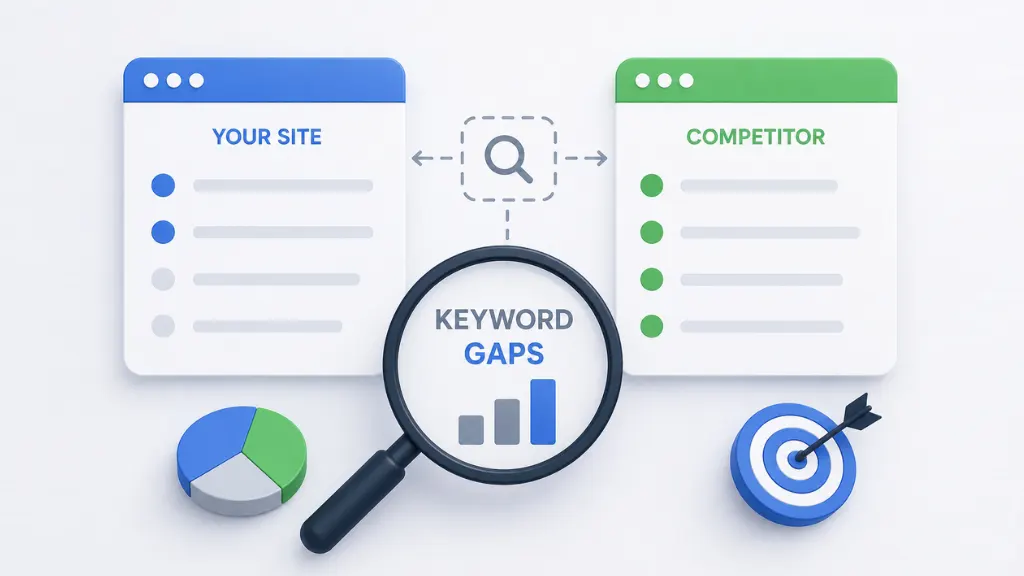
Look for Keyword Gaps
Keyword research can also reveal topics your competitors cover that your website doesn’t.
Suppose competing websites rank for:
- local SEO checklist
- Google Business Profile optimization
- local keyword research
- local citations
If your website only has a general local SEO page, these related topics may provide ideas for additional content.
However, don’t create pages just to match competitors. Each page should have a clear purpose and provide something useful.
Group Similar Keywords Together
You don’t need to create a separate page for every keyword variation.
For example:
- SEO content writing
- SEO content writer
- SEO writing services
- SEO content writing service
These phrases may belong to the same topic depending on search intent and the search results. Instead of creating four nearly identical pages, you may be able to create one strong page that naturally covers the topic. This helps prevent thin or repetitive content.
Don’t Ignore Existing Keywords
Your website may already rank for useful keywords that you haven’t intentionally targeted.
Google Search Console can show:
- Search queries
- Impressions
- Clicks
- Average position
- Click-through rate
Look for keywords where your page already receives impressions but has a relatively low ranking. Sometimes, improving an existing page can produce better results than creating a completely new page.
For example, a page ranking around position 8–15 may have more potential than a brand-new page with no search visibility.
Avoid Keyword Stuffing
Once you choose a keyword, don’t repeat it unnaturally.
For example, avoid writing:
Our SEO services are the best SEO services because our SEO services provide professional SEO services for businesses looking for SEO services.
Instead, write naturally and use related terms where appropriate. Search engines can understand topics through context, related words, and the overall content. Your priority should be creating a useful page for the reader.

Common Keyword Research Mistakes
Choosing Keywords Only by Search Volume: High-volume keywords aren’t automatically better.
Ignoring Search Intent: A keyword may look relevant but attract the wrong type of visitor.
Targeting Extremely Competitive Keywords: New websites may struggle to compete with established domains for broad terms.
Creating One Page for Every Keyword: Similar keywords can often be covered on one well-structured page.
Using Irrelevant Keywords: Traffic doesn’t help if visitors have no interest in your products or services.
Forgetting Local Search: Businesses serving specific locations should consider location-based keywords where appropriate.
Final Thoughts
Choosing the right keywords for your site is not simply about finding those key search terms. Now we need to tie keyword research to audience, business goals, search intent, competition and purpose for every page.
Begin with those products and services of yours. From there, determine your audience’s search queries, create a list of keywords, scour the data to be found and explore Google’s SERPs.
Then the next step is to choose keywords, not by search volume, but rather by taking into account the relevance and business viability.
Above all, SEO is NOT about driving as much traffic from search engines. The right traffic is what it asserts to acquire. It is always better to target a smaller group of audience who actually need your product or service rather than alarming thousands of visitors and see them go without doing anything.