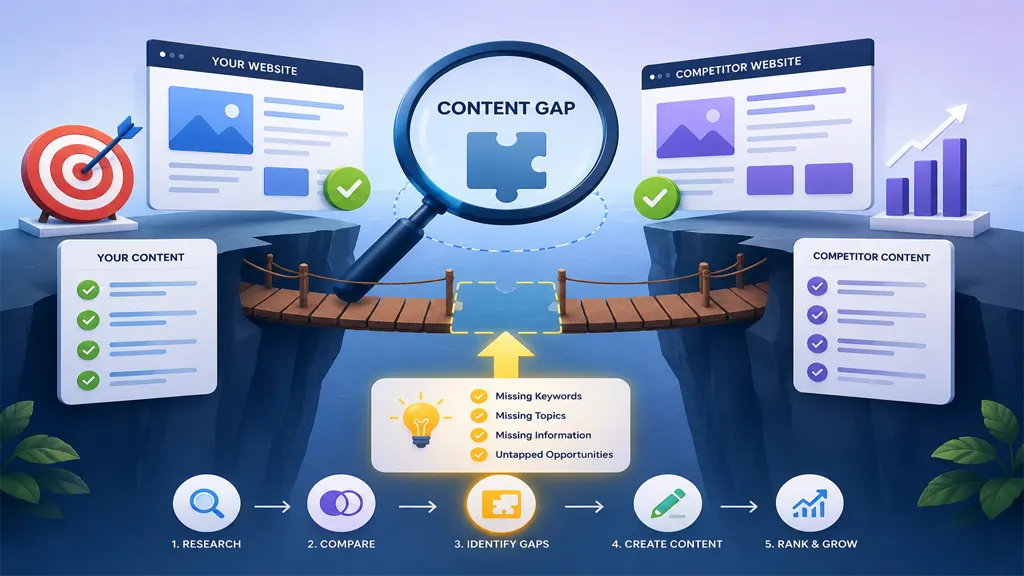
Content is one of the most important factors in SEO success. However, creating content alone is not enough. Your website must cover the topics, questions, and keywords your audience is actively searching for. Otherwise, you risk losing valuable traffic to competitors. This is where content gap analysis becomes essential.
What is content gap analysis in SEO? It is the process of identifying missing content, keywords, and topics that your target audience is searching for but your website does not currently address. By finding and filling these gaps, businesses can improve search visibility, increase organic traffic, and strengthen their overall SEO strategy.
Whether you run a blog, an eCommerce store, or a business website, content gap analysis can help uncover opportunities that drive measurable growth. In this guide, you’ll learn what content gap analysis is, why it matters, how to perform it, and the best practices for maximizing results.
What Is Content Gap Analysis in SEO?
Content gap analysis is the process of comparing your website’s content against user needs, competitor content, and search demand to identify missing opportunities.
In simple terms, it helps answer questions such as:
- What topics are competitors covering that you are not?
- Which keywords are driving traffic to competitor websites?
- What questions are your customers asking that remain unanswered?
- Which content pieces need updating or expansion?
By identifying these gaps, you can create content that better meets user intent and improves your website’s ability to rank in search engines.
As a result, content gap analysis has become a crucial part of modern SEO strategies.
Types of Content Gaps in SEO
Not all content gaps are the same. Understanding the different types helps prioritize your optimization efforts.
Keyword Gaps
Keyword gaps occur when competitors rank for keywords that your website does not target. For example, a competitor may rank for “technical SEO checklist” while your site has no content covering that topic. Consequently, you’re missing potential traffic and visibility.
Topic Gaps
Topic gaps happen when your website fails to cover important subjects within your niche. For instance, if you run a digital marketing blog but lack content on local SEO, that’s a topic gap. As a result, your website may appear less authoritative to both users and search engines.
Content Quality Gaps
Sometimes content exists but lacks depth, accuracy, or relevance. Therefore, updating and improving existing pages can help close quality gaps.
Intent Gaps
User intent refers to the reason behind a search query. If your content does not match user expectations, it may struggle to rank even if it targets the correct keyword. Because of this, understanding search intent is critical.
Format Gaps
Users consume content in different formats.
Some prefer:
- Blog posts
- Videos
- Infographics
- Case studies
- FAQs
Consequently, offering multiple content formats can improve engagement and search performance.
Best Tools for Content Gap Analysis
Several SEO tools simplify content gap analysis.
Ahrefs
Ahrefs offers a Content Gap tool that shows keywords competitors rank for while your website does not. Additionally, it provides valuable backlink and content insights.
SEMrush
SEMrush includes keyword gap and content gap analysis features. Therefore, marketers can quickly identify missed opportunities.
Google Search Console
Google Search Console reveals search queries already generating impressions. As a result, it helps uncover opportunities for content expansion.
Google Analytics
Google Analytics helps identify high-performing and low-performing content. Consequently, optimization efforts become more strategic.
Moz
Moz provides keyword tracking and competitive analysis tools useful for discovering content gaps.
Conclusion
Content gap analysis is one of the most effective ways to uncover new SEO opportunities and improve search visibility. By identifying missing keywords, topics, and user needs, businesses can create more comprehensive content that attracts organic traffic and strengthens topical authority.
Rather than guessing what content to create next, content gap analysis provides a data-driven approach to content planning. Moreover, it helps businesses stay competitive in increasingly crowded search results.
Whether you’re a blogger, marketer, or business owner, incorporating content gap analysis into your SEO strategy can lead to better rankings, increased traffic, and sustainable long-term growth.
FAQ's
Content gap analysis in SEO is the process of identifying missing content, keywords, or topics that your audience is searching for but your website does not currently cover.
It helps uncover opportunities to improve rankings, increase organic traffic, strengthen topical authority, and create content that better serves user needs.
Popular tools include Ahrefs, SEMrush, Google Search Console, Google Analytics, and Moz.
Most websites benefit from conducting content gap analysis every three to six months or whenever major changes occur in their industry.
Yes. By filling missing content opportunities and addressing user intent more effectively, content gap analysis can significantly improve search rankings and organic traffic.