
Search engine marketing (SEM) is an online advertising strategy used to boost the visibility of a business’s website through search engines. This usually consists of PPC (pay-per-click) advertising, meaning the company pays to show ads whenever a user searches something related.
For instance, if a user tries to search for “digital marketing agency” the SERP will display paid ads on top of or below the organic results. This is generally used by businesses to advertise their products/services to the people who are already looking for them.
But SEM is more than just creating an ad. Keyword research, target audience, focusing on ad copy and landing page optimization also come into play by allocating proper budgets for a successful search marketing campaign with conversion tracking followed by periodic testing.
What Is Search Engine Marketing?
Search engine marketing is the practice of promoting a business through search engine advertising and other search-focused marketing activities.
In modern digital marketing, SEM commonly refers to paid search advertising, such as Google Ads. Businesses bid on relevant keywords, and their ads may appear when users search for those terms.
For example, a web development company could create ads targeting:
- Web development services
- Web application development company
- Custom web development
- Web development agency
- Hire web developer
When someone searches for one of these terms, the company may compete to show an advertisement.
The business usually pays when someone clicks the ad. This model is commonly known as pay-per-click (PPC) advertising.
How Does Search Engine Marketing Work?
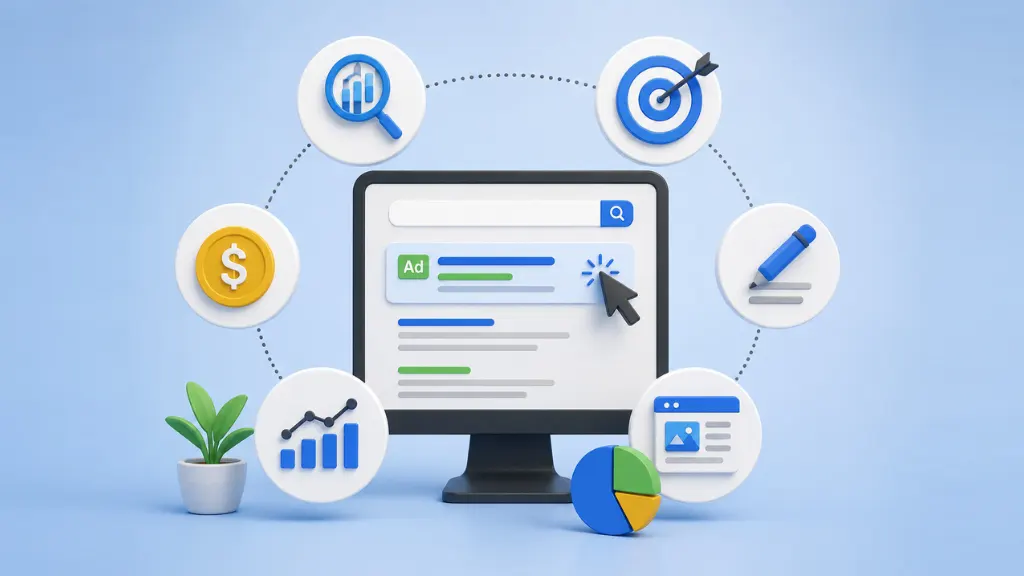
SEM works through an advertising auction. When someone performs a search, the search engine evaluates eligible advertisements for that query. Several factors can influence which ads appear and where they appear.
These factors can include:
- Keyword relevance
- Bid
- Ad quality
- Landing page experience
- Expected performance
- Search context
- Geographic location
- Device
- Audience settings
Therefore, simply spending more money doesn’t guarantee the best position.
A highly relevant advertisement with a good landing page can perform well without relying entirely on a high bid.
For example, imagine two companies advertise for the keyword “SEO services for small business.”
Company A sends visitors to a general homepage. Company B sends visitors to a dedicated page explaining its small-business SEO services, pricing approach, process, and benefits.
Even if both companies compete for the same keyword, Company B may provide a better experience because the landing page closely matches the user’s search.
What Are the Main Components of SEM?
A search marketing campaign usually includes several connected parts.
Keyword Research
Keyword research helps identify the terms potential customers use when searching.
For example, a solar company might research:
- Solar panels
- Solar panel installation
- Solar panel price
- Solar system for home
- Solar inverter
- Solar battery
However, search volume alone shouldn’t determine your keyword selection.
You should also consider search intent, competition, commercial value, and whether the keyword matches your offering.
Ad Campaigns
After selecting keywords, marketers create campaigns and ad groups around related topics.
For example, an agency might create separate campaigns for:
- SEO services
- PPC services
- Social media marketing
- Content marketing
This structure makes it easier to manage budgets and measure performance.
Ad Copy
Ad copy needs to communicate the offer quickly.
A strong search ad may include:
- A clear benefit
- Relevant keywords
- A specific service
- A call to action
- A reason to choose the business
Instead of making vague claims, focus on what the customer can actually expect.
Landing Pages
The landing page is where the visitor goes after clicking an advertisement. It should match the promise made in the ad.
For example, an advertisement for “product photo editing services” should ideally lead to a page specifically about product photo editing rather than a generic homepage.
A good landing page should also make it easy for visitors to understand the offer and take the next step.
Conversion Tracking
Clicks don’t tell you whether a campaign is profitable.
Conversion tracking helps you measure actions such as:
- Form submissions
- Phone calls
- Purchases
- Sign-ups
- Bookings
- Quote requests
- Downloads
This information helps marketers understand which campaigns and keywords contribute to business results.
SEM vs SEO: What’s the Difference?
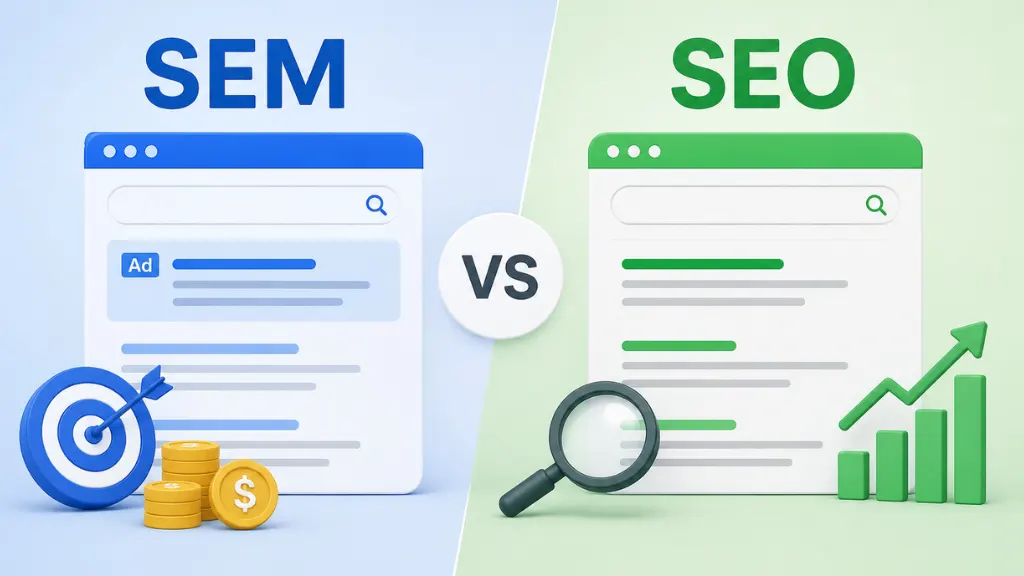
SEM and SEO both focus on search engines, but they work differently. SEO focuses on improving organic search visibility. SEM, in its common modern usage, focuses mainly on paid search advertising.
For example:
| SEO | SEM |
| Organic visibility | Paid visibility |
| No payment for each organic click | Often pay per click |
| Usually takes time to build | Can generate traffic quickly |
| Focuses on content and website optimization | Focuses on advertising campaigns |
| Long-term traffic potential | Immediate campaign traffic |
However, SEO and SEM don’t have to compete with each other. A business can use both.
For example, a company could run Google Ads to attract immediate leads while building SEO content to increase organic visibility over time.
Why Is Search Engine Marketing Important?
Search engines capture people at different stages of the buying process. Someone might search for an informational topic first. Later, they may search for reviews, pricing, or a specific service. SEM allows businesses to appear when users are actively searching for relevant products or services.
It can help businesses:
- Reach potential customers quickly
- Generate targeted website traffic
- Promote specific products
- Generate leads
- Increase online sales
- Test market demand
- Reach specific locations
- Control advertising budgets
For example, a local plumbing company can target searches within its service area instead of showing advertisements to people across an entire country. As a result, the business can spend its budget on a more relevant audience.
Benefits of Search Engine Marketing
Faster Visibility
One of the biggest advantages of paid search is speed. A new website may take time to build organic search visibility. However, an appropriately configured advertising campaign can start generating impressions and clicks soon after launch. That doesn’t mean every campaign will succeed immediately. You still need good targeting, relevant ads, and a strong landing page.
Targeted Traffic
SEM allows businesses to target specific keywords and audiences. Depending on the advertising platform, marketers can also adjust campaigns based on factors such as:
- Location
- Language
- Device
- Audience
- Time
- Search behavior
This level of control can help businesses reach people who are more likely to need their products or services.
Budget Control
Businesses can set campaign budgets and adjust spending based on performance. For instance, you might increase spending on campaigns that generate qualified leads while reducing spending on campaigns that produce clicks but few conversions. Still, budget control doesn’t mean every click will be profitable. You need accurate conversion tracking to make good decisions.
Measurable Results
SEM provides detailed performance data.
You can track metrics such as:
- Impressions
- Clicks
- Click-through rate
- Cost per click
- Conversion rate
- Cost per conversion
- Conversion value
- Return on ad spend
These metrics help you understand what is working and where your campaign needs improvement.
What Is PPC in Search Engine Marketing?
PPC stands for pay-per-click. It’s an advertising model where an advertiser generally pays when someone clicks an advertisement. Google Ads is one of the best-known PPC platforms.
For example, suppose you advertise a service with a maximum cost of $2 per click. If 100 people click your advertisements, your click cost could be around $200, although actual costs depend on the auction and campaign settings.
However, the cost of clicks isn’t the only thing that matters. If those 100 clicks produce 10 qualified leads, the campaign may be useful. If they produce zero leads, the campaign needs attention. Therefore, SEM should be measured against business outcomes rather than clicks alone.

How to Create an SEM Campaign
A basic SEM campaign can follow these steps.
1: Define Your Goal
First, decide what you want to achieve.
Your goal could be:
- Generate leads
- Increase sales
- Get phone calls
- Promote a service
- Drive bookings
- Increase registrations
A clear goal makes campaign measurement easier.
2: Research Keywords
Find keywords that match your products or services. Then, separate them according to search intent.
For example:
Informational:
“What is SEO?”
Commercial:
“Best SEO agency”
Transactional:
“Hire SEO agency”
The last type generally shows stronger purchase intent.
3: Create Relevant Ad Groups
Group related keywords together. For example, keywords related to local SEO should generally have ads that specifically discuss local SEO. This creates a stronger connection between the search, advertisement, and landing page.
4: Write the Ads
Create several variations of your ad copy. Test different headlines, benefits, offers, and calls to action. Avoid making claims that you cannot support.
5: Build or Select a Landing Page
Send visitors to a page that closely matches their search and advertisement. Keep the main action clear.
For example, if your goal is lead generation, make your contact form or quote request option easy to find.
6: Track Conversions
Set up conversion tracking before making major campaign decisions. Otherwise, you may know how many people clicked but not how many became customers.
7: Test and Improve
Review campaign performance regularly.
Look for:
- Expensive keywords
- Low-converting searches
- Strong-performing ads
- Poor landing pages
- Irrelevant search terms
- Geographic areas with weak performance
Then make changes based on the data.
Common SEM Mistakes to Avoid
Targeting Too Many Broad Keywords: Broad keywords can attract a large number of irrelevant searches.
Sending Every Visitor to the Homepage: A dedicated landing page often makes more sense for a specific advertising campaign.
Ignoring Search Terms: Reviewing actual search queries can help you identify irrelevant traffic and opportunities for negative keywords.
Focusing Only on CTR: A high click-through rate doesn’t necessarily mean a campaign makes money. A campaign with a lower CTR but better conversion rate may produce better business results.
Not Tracking Conversions: Without conversion data, it’s difficult to know whether your advertising budget is producing meaningful results.
Making Unrealistic Promises: Avoid claims such as guaranteed rankings, guaranteed sales, or guaranteed results unless you can genuinely support them.

How Much Does Search Engine Marketing Cost?
There isn’t one fixed SEM price.
Your costs can depend on:
- Industry
- Keyword competition
- Location
- Target audience
- Campaign settings
- Quality of your ads
- Landing page experience
- Conversion rate
- Daily budget
A highly competitive industry may have much higher click costs than a less competitive niche.
Therefore, businesses should determine their budget based on expected customer value and conversion performance rather than choosing an arbitrary amount.
Is SEM Suitable for Small Businesses?
Yes. Small businesses can use SEM when they target their campaigns carefully.
For example, a local business doesn’t necessarily need to advertise across an entire country. Instead, it can focus on a specific city, service area, or group of high-intent keywords.
A small business can also start with a limited budget, measure results, and gradually adjust spending based on performance.
However, the campaign needs proper tracking and management. Otherwise, even a small budget can be wasted on irrelevant clicks.
Final Thoughts
Search Engine Marketing allows a business to attract search-focused customers with advertising. It can offer quicker visibility, geo-targeted audience, performance history measurement, and budget control for the advertisers.
But SEM success, simply put, is not about clicks with money. Your pick of keywords, ad copy, landing pages, targeting, budget and conversion tracking offset one other.
To make the most of your efforts, keep your sights set on searches that have relevance to you. Next, write the relevant ads and drive our visitors to pages that can deliver on the promise you’ve made in your ad.
Last but not least, track conversions instead of only clicks. This will help you use your ad spend wisely and to identify how to optimize your search marketing campaigns.