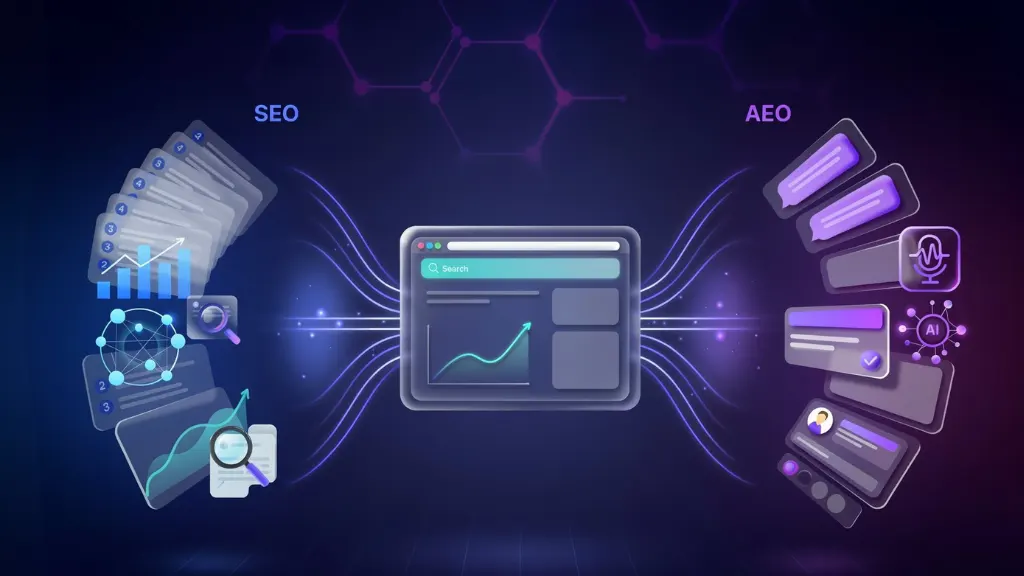
In today’s digital world, businesses must adapt to the way people search for information online. Traditional search engines like Google remain important; however, AI-powered platforms and answer engines are rapidly changing user behavior. As a result, marketers and business owners are increasingly asking: what is SEO and AEO?
Understanding SEO and AEO is essential because both strategies help businesses improve their online visibility. While SEO focuses on ranking webpages in search engine results, AEO focuses on providing direct answers to users’ questions through AI assistants, voice search devices, and answer engines.
Moreover, as search technology evolves, businesses that combine SEO and AEO strategies can gain a significant competitive advantage. Therefore, learning how these two approaches work together is crucial for long-term digital success.
In this guide, we’ll explore SEO and AEO, their differences, benefits, best practices, and how organizations can leverage both to increase visibility, traffic, and conversions.
What Is SEO and AEO in Digital Marketing?
SEO (Search Engine Optimization) is the process of improving a website’s visibility in search engine results pages (SERPs). The goal is to increase organic traffic by helping webpages rank higher for relevant keywords.
AEO (Answer Engine Optimization), on the other hand, is the process of optimizing content so that AI-powered systems, voice assistants, and answer engines can quickly understand and deliver direct answers to users.
Although both strategies aim to increase online visibility, they focus on different search experiences. SEO helps users find your website, whereas AEO helps answer users’ questions instantly.
Consequently, businesses need to optimize for both search engines and answer engines to stay relevant.
What Is SEO?
SEO is a digital marketing strategy that helps websites appear higher in search results when users search for specific keywords or topics.
For example, when someone searches for “best running shoes,” search engines analyze millions of pages and display the most relevant results.
SEO helps ensure your content is among those results.
Key Components of SEO:
1. Keyword Research
Keyword research involves identifying the words and phrases users enter into search engines.
For instance, if your target keyword is digital marketing, your content should naturally address that topic while providing valuable information.
2. On-Page SEO
On-page SEO focuses on optimizing individual pages.
This includes:
- Title tags
- Meta descriptions
- Headers
- Internal links
- URL structure
- Image optimization
As a result, search engines can better understand page content and relevance.
3. Technical SEO
Technical SEO ensures websites are easy for search engines to crawl and index.
Important factors include:
- Site speed
- Mobile responsiveness
- XML sitemaps
- HTTPS security
- Structured data
Therefore, strong technical SEO improves both rankings and user experience.
4. Content Optimization
High-quality content remains one of the most important ranking factors.
Search engines prioritize content that is:
- Relevant
- Helpful
- Accurate
- Comprehensive
- User-focused
Consequently, businesses should create content that genuinely solves user problems.
5. Link Building
Backlinks from authoritative websites signal trust and credibility.
Because search engines view backlinks as endorsements, quality links can significantly improve rankings.
What Is AEO?
AEO stands for Answer Engine Optimization.
Unlike traditional SEO, AEO focuses on helping AI-powered systems provide direct answers to users.
Today, people increasingly use:
- ChatGPT
- Google AI Overviews
- Siri
- Alexa
- Google Assistant
- Microsoft Copilot
Instead of clicking multiple search results, users often expect immediate answers.
As a result, businesses must optimize content to become the source of those answers.
What Is SEO and AEO: Key Differences
Although SEO and AEO share similarities, they have distinct objectives.
Feature | SEO | AEO |
Primary Goal | Rank webpages | Provide direct answers |
Target Platform | Search engines | AI assistants and answer engines |
Focus | Traffic generation | Information delivery |
Content Format | Articles, pages, blogs | FAQs, concise answers, structured content |
User Behavior | Click and browse | Ask and receive answers |
Success Metric | Rankings and traffic | Answer visibility and citations |
However, despite these differences, SEO and AEO complement each other rather than compete.
What Is SEO and AEO Strategy?
A modern digital strategy should integrate both SEO and AEO.
Optimize for Search Intent
Understanding user intent is critical.
Users may be:
- Looking for information
- Comparing products
- Seeking solutions
- Ready to purchase
Therefore, content should align with what users actually want.
Create Question-Based Content
Answer engines frequently pull information from content that directly answers questions.
Examples include:
- How does AEO work?
- Why is SEO important?
As a result, FAQ sections can significantly improve AEO performance.
Use Structured Data
Schema markup helps search engines and AI systems understand content more effectively.
Structured data can improve:
- Featured snippets
- Rich results
- AI-generated summaries
Consequently, businesses should implement relevant schema whenever possible.
Improve Content Clarity
Answer engines prefer concise and accurate information.
Therefore:
- Use short paragraphs.
- Include clear headings.
- Answer questions directly.
- Avoid unnecessary complexity.
This approach benefits both SEO and AEO.
Conclusion
Understanding SEO and AEO is essential for businesses that want to succeed in modern search environments.
SEO helps websites rank higher in traditional search engine results and attract organic traffic. Meanwhile, AEO helps content become the source of direct answers delivered by AI assistants, voice search platforms, and answer engines.
Although the two strategies have different objectives, they work best when combined. Therefore, businesses should focus on creating high-quality content, optimizing for user intent, implementing structured data, and providing clear answers to common questions.
As search behavior continues to evolve, organizations that invest in both SEO and AEO will be better positioned to increase visibility, build authority, and drive long-term growth.